Top Free AI Tools for Healthy Eating in 2026
AI & NUTRITIONFEATURED
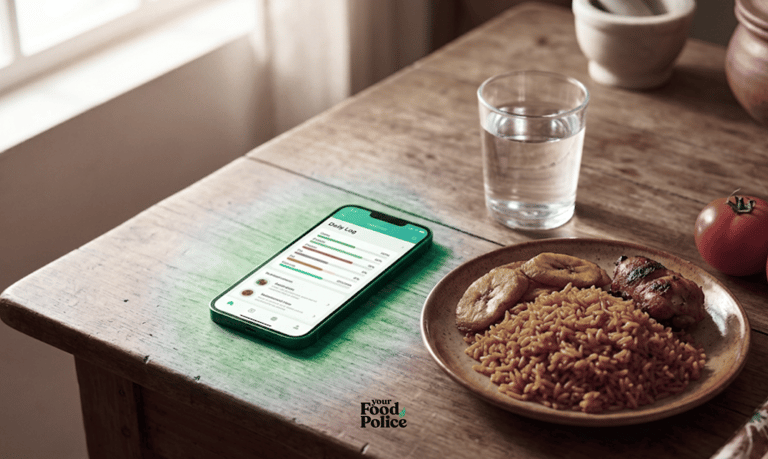
TLDR: You don't need to pay for nutrition apps. Use ChatGPT to plan meals in naira, Cronometer to track vitamins and minerals, SnapCalorie to photograph your plate for instant calories, Open Food Facts to scan labels at the supermarket, and Google Gemini to fact-check nutrition claims on social media. All free. All work for Nigerian food if you use them right. No single tool does everything, but two or three of them together give you better insight than most paid apps on the market.
You don't need to spend a single naira on nutrition apps to eat healthier.
In 2026, free AI tools can plan your meals around what's available at your market, estimate your calories from a photo of your plate, decode food labels at Shoprite, and answer specific nutrition questions, all without a subscription.
But here's the thing most "best AI tools" articles won't tell you: the majority of these tools were built for people eating salads in San Francisco, not someone dishing amala and ewedu in Surulere.
So I tested the most popular free options and ranked them based on one question - does this actually work if you eat Nigerian food, shop at Nigerian markets, and live on a Nigerian budget?
Six tools made the cut. Let me walk you through each one.
What Can AI Nutrition Tools Actually Do for You?
Most people who come to me as clients know they should "eat healthier."
The problem is never motivation, it's logistics. How many calories are in this plate of jollof rice? What should I cook this week on ₦10,000? Is this "sugar-free" yoghurt actually sugar-free? Should I be worried about how much garri I eat?
These are real questions, and answering them used to require either a nutrition consultation or hours of research. Now? A free AI tool can handle most of them in under 30 seconds.
I'm not saying these tools replace a nutritionist/dietitian - they don't (and I would say that even if my livelihood didn't depend on it).
But for everyday healthy eating? They remove the guesswork that stops most people from starting.
Here's the twist though: each tool solves a different problem. There's no single app that does everything well. The smartest approach is using two or three of them together, which I'll show you how to do at the end.
6 Top Free AI Tools for Healthy Eating
1. ChatGPT
If I could only recommend one AI tool for healthy eating in Nigeria, this would be it.
Not because it's perfect, but because it's the most flexible. ChatGPT is a general-purpose AI chatbot - it wasn't built specifically for nutrition - but when you prompt it correctly, it becomes the most useful meal planning tool available. And the free version is more than enough.
Here's what makes it powerful: you can tell ChatGPT exactly who you are and what you need.
Try this prompt and see what happens:
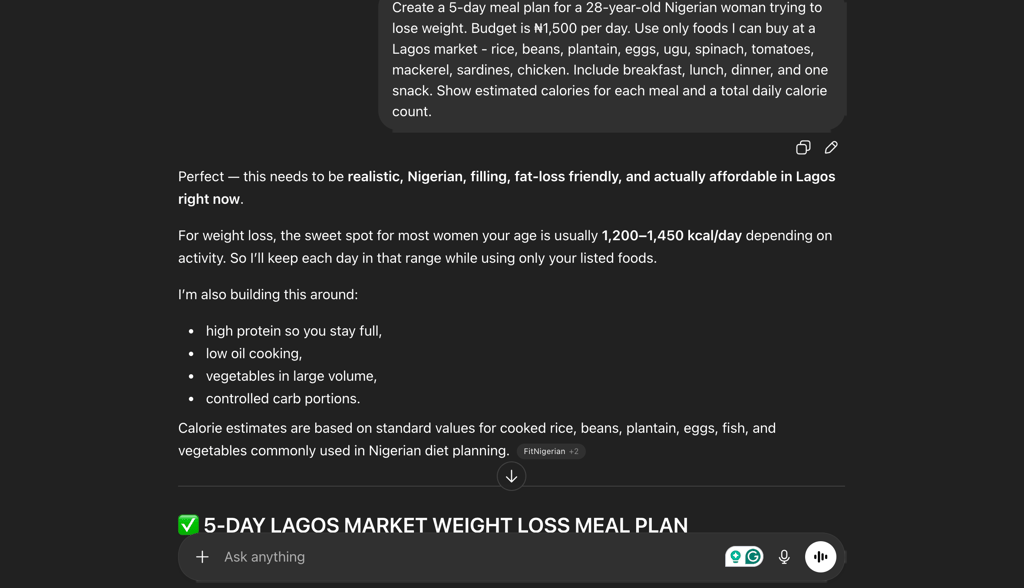
"Create a 5-day meal plan for a 28-year-old Nigerian woman trying to lose weight. Budget is ₦1,500 per day. Use only foods I can buy at a Lagos market - rice, beans, plantain, eggs, ugu, spinach, tomatoes, mackerel, sardines, chicken. Include breakfast, lunch, dinner, and one snack. Show estimated calories for each meal and a total daily calorie count."
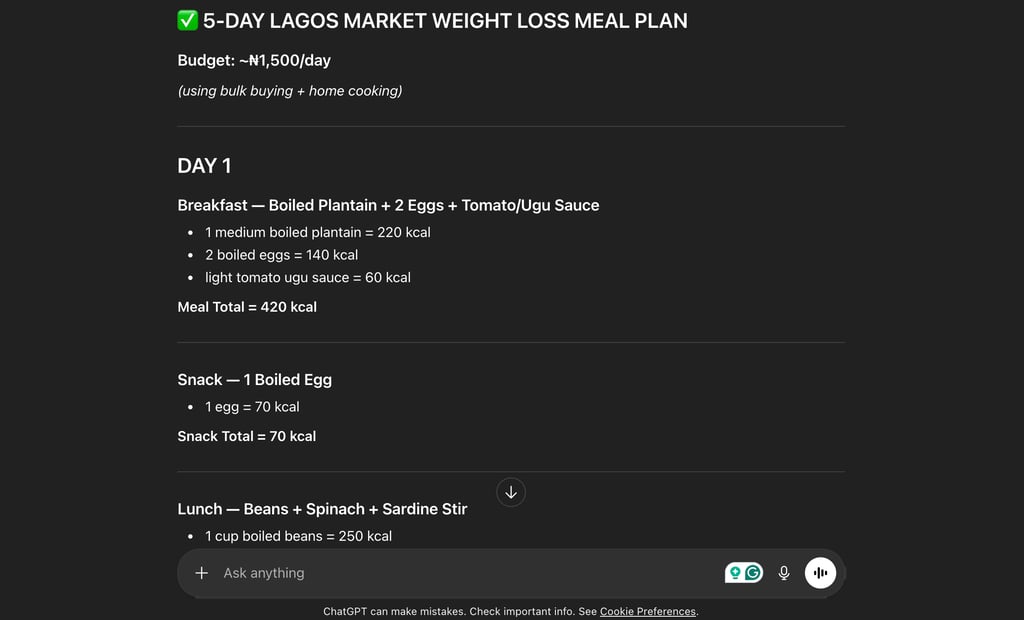
That one prompt will give you a more useful, more Nigerian, more budget-aware meal plan than most paid apps on the market.
I've tested this with clients, and the plans it generates are genuinely reasonable, not perfect, but a solid 70–80% starting point that you can then adjust based on what's actually available and affordable that week.
You can also use ChatGPT to decode food labels (paste the ingredient list and ask "what should I be concerned about?"), generate grocery lists from a meal plan, convert a recipe into a healthier version, or get a quick answer to any nutrition question.
The catch? ChatGPT doesn't track anything. It won't remember what you ate yesterday, calculate your weekly calorie average, or monitor your progress. It's a planning tool, not a tracking tool.
And if you don't specifically tell it you want Nigerian food, it will default to Western suggestions.. quinoa this, kale that. You have to steer it.
Also, its calorie estimates are approximations. If it says your rice and stew is 550 calories and the real number is 650, that's close enough for general healthy eating, but not precise enough for medical nutrition therapy.
What it costs: Free (GPT-4o with daily limits). You don't need the paid plan for meal planning.
2. Cronometer
Most calorie trackers tell you how much protein, carbs, and fat you ate.
Cronometer tells you how much iron, zinc, folate, vitamin B12, magnesium, vitamin D, and 78 other nutrients you got. And the free version gives you all of that - no paywall on the actual nutrition data.
Why does this matter for Nigerians specifically?
Because micronutrient deficiency is a serious problem here and most people don't know they have one.
According to a systematic review published in Nutrients, zinc deficiency among Nigerian women of reproductive age is around 46%, and anaemia - often caused by iron deficiency - affects 58% of pregnant women and 68% of children under five, based on the 2018 Nigeria Demographic and Health Survey.
Vitamin A deficiency has been documented at 44% among adolescent students in some Nigerian urban communities.
You can eat enough calories and still be deficient in critical nutrients. Cronometer is the only free tool that helps you spot those gaps.
The trade-off is the database is heavily North American. You won't find "pounded yam and egusi soup" as a single entry. You'll need to build your own recipes by adding individual ingredients - pounded yam, egusi seeds, palm oil, crayfish, ugu, stockfish, and so on. This takes about five minutes per recipe, but once you save it, you can log that meal with one tap forever.
Cronometer's database pulls from lab-verified sources like the USDA FoodData Central and the NCCDB not from random users submitting guesses. So when it says your beans gave you 3.5mg of iron, that number is backed by actual lab data, not someone's approximation.
What it costs: Free with ads. The Gold upgrade (about $5/month) removes ads and adds features like the "Oracle" that suggests foods when you're low on a specific nutrient. But the free tier covers everything most people need.
3. SnapCalorie
SnapCalorie was built by former Google AI researchers, and the accuracy shows. Take a photo of your food — the app uses your phone's depth sensor to estimate volume, identifies individual items on the plate, and gives you calories, protein, carbs, fat, and over 30 micronutrients. No typing. No searching through databases. Just snap and go.
For a plate of white rice with fried plantain and grilled chicken? The estimates are genuinely reasonable.
But ask it to figure out what's inside your bowl of ogbono soup? That's where it struggles. Blended, stew-based, and soup-heavy Nigerian dishes confuse most AI food scanners because the individual ingredients aren't visually distinct. Is that egusi or efo riro? How much palm oil went in? The AI can't tell, and those invisible calories add up fast.
Here's a practical workaround: use SnapCalorie for the parts of your meal it can clearly see (the rice, the plantain, the protein), then manually add the soup or stew using Cronometer or a quick ChatGPT estimate. It's an extra 30 seconds, but you'll get a much more accurate total.
The free tier gives you three photo scans per day. If you eat three main meals and that's your tracking window, three scans is enough. If you snack between meals (and most people do) you'll hit the limit. The paid version unlocks unlimited scans, but honestly? Three scans plus manual adjustments works fine for building awareness.
One more thing: SnapCalorie can't detect cooking oil, butter, or sauces that aren't clearly visible. A piece of grilled fish looks the same whether it was brushed with 5ml of oil or drenched in 30ml.
That difference is over 200 calories. So when you review SnapCalorie's estimate, always ask yourself: "did I add oil or fat that the camera couldn't see?" Then adjust accordingly.
What it costs: Free (3 scans/day). Paid plan for unlimited scans.
4. Open Food Facts
This one is different from the others.
Open Food Facts isn't an AI chatbot or a calorie tracker. It's a non-profit, community-driven database of packaged food products from around the world. Download the app (Android | iOS), scan a barcode at Shoprite, SPAR, or Justrite, and you'll see the full nutritional breakdown, ingredient list, and a processing score that tells you how ultra-processed the product is.
That processing score - called the NOVA classification - is the reason I recommend this app.
NOVA groups foods from 1 (minimally processed, like whole grains and fresh fruit) to 4 (ultra-processed, like most instant noodles, flavoured yoghurts, and packaged snacks). This matters because a growing body of research links ultra-processed food consumption to obesity, type 2 diabetes, and cardiovascular disease — and the Nigerian diet has been shifting steadily toward more processed products over the past decade.
Next time you pick up a pack of "whole wheat" biscuits or "sugar-free" cereal at the supermarket, scan it. You might be surprised by what's actually inside.
One thing to know: Open Food Facts relies on users to add products to the database.
Major international brands sold in Nigeria - Nestlé, Kellogg's, Dangote products - are well-covered. Smaller Nigerian brands might not have entries yet. But if you scan something that's not in the database, the app walks you through adding it in about two minutes. You're helping the next person who picks up that same product.
Also worth mentioning: Yuka is a popular food scanner app you might have heard about on social media. It's not available in Nigeria - the app is geo-restricted here. Open Food Facts does the same job and doesn't cost you anything, ever.
What it costs: Completely free, always. Non-profit, no ads, open-source.
5. Google Gemini
Someone on TikTok told you drinking okra water will cure your diabetes. Your auntie says eating eggs every day is bad for your heart. Your gym buddy swears that eating after 7pm makes you gain weight. Who is right?
Google Gemini can settle these arguments in about 10 seconds.
Gemini is Google's free AI chatbot, and what sets it apart from ChatGPT for nutrition questions is its direct access to Google Search.
When you ask it a question, it pulls from current research, health guidelines, and published studies - and shows you the sources. So you're not just getting an AI opinion, you're getting cited information you can actually verify.
Try asking it: "Is palm oil bad for your heart? Show me what recent research says." You'll get a nuanced, balanced response that references specific studies - not a yes-or-no oversimplification.
I use Gemini in my own practice when I need a quick refresher on a specific nutrient interaction or want to pull up data for a client session. It's not a replacement for proper academic databases like PubMed, but for everyday nutrition questions? It's fast, reliable, and free.
Like ChatGPT, Gemini won't track your meals or monitor your progress. It's a question-and-answer tool. But considering how much nutrition misinformation circulates on Nigerian social media, having a reliable fact-checker in your pocket is genuinely valuable.
What it costs: Free.
6. MyFitnessPal
I almost didn't include MyFitnessPal because the free version got significantly worse in 2026.
The barcode scanner moved behind the paywall. The AI photo scanning feature? Also paywalled. If you want AI-powered anything in MFP now, you're paying about $20 per month, which is wild.
So why is it still on this list? One reason: database size.
MyFitnessPal has over 14 million food entries - the largest of any nutrition app - and because users worldwide contribute entries, you'll find more Nigerian foods here than in any other tracker. Search "jollof rice" and you'll get multiple entries. Search "puff puff," "suya," "masa," "dodo" - they're all there.
If you're comfortable with manual logging (typing a food name, selecting the entry, adjusting the portion), MyFitnessPal's free tier still lets you track calories and macros. No photo scanning, no barcode reading, and yes, there are ads but the database itself is extensive.
The accuracy issue: because anyone can submit food entries, quality varies. You might find three different calorie counts for "fried plantain" depending on who entered it.
My advice? When multiple entries appear, pick the one from a verified source (usually marked with a green checkmark) or the one closest to what you'd find in a standard food composition table.
What it costs: Free with limitations and ads. Premium is about $20/month.
The ₦0 Nutrition Stack: How to Use These Tools Together
No single tool does everything. But combine a few of them and you've got a system that rivals any paid nutrition app, for free.
Here's what I recommend:
Sunday: Open ChatGPT and generate your meal plan for the week. Tell it your budget, what's in season, what you have at home, and your health goals. Save the plan in your notes app.
At the market or supermarket: Open Food Facts for packaged products. Scan before you buy. If the NOVA score says 4 and you thought you were buying something healthy, put it back and find an alternative.
During meals (2–3 times a week, not every meal): Snap a photo with SnapCalorie for a quick calorie check. You don't need to do this forever — two or three weeks of consistent photo logging builds enough portion awareness that you'll start estimating naturally.
One day per week: Log everything you ate that day in Cronometer. Check the micronutrient summary at the end. Are you consistently low on iron? Zinc? Vitamin D? That pattern tells you something valuable about your diet that calorie counting alone will never reveal.
Whenever you see a wild nutrition claim online: Ask Google Gemini. Get the evidence. Stop forwarding misinformation to your family WhatsApp group.
Total cost: ₦0.
What AI Nutrition Tools Get Wrong (And Why You Should Still Use Them)
Let me be straight with you - these tools have real limitations, especially for Nigerians.
Portions are almost always off. Most AI tools base their estimates on Western portion sizes. A "standard serving" of rice in these databases might be 150–200g. A typical plate at your local buka? Easily 400–500g. If you don't adjust for this, you'll think you're eating 500 calories when you're actually eating 900. Always double the AI's portion estimate for Nigerian servings and work backwards from there.
Cooking oil is the invisible calorie bomb. Every stew, soup, and fried food in Nigerian cooking involves oil - palm oil, groundnut oil, vegetable oil. AI photo scanners cannot see oil. A piece of grilled chicken and a piece of fried chicken look different to your eyes, but many AI tools estimate them the same way. When in doubt, add 100–200 extra calories to any meal that involved frying or heavy oil.
These tools are not doctors. I need to say this clearly: if you're managing diabetes, kidney disease, hypertension, PCOS, or any condition that requires a therapeutic diet, free AI tools are not a substitute for working with a registered dietitian. They can complement professional guidance, but they should never replace it. A generic AI meal plan won't account for your medication interactions, your specific lab values, or the particular way your body responds to certain foods.
Your data goes somewhere. Every free AI tool collects information about what you eat, your health goals, and your usage patterns. Most use this data to improve their products, and some share it with third parties. I'm not saying don't use them, I'm saying read the privacy policy and decide what you're comfortable sharing.
How Accurate Are AI Calorie Estimates, Really?
No AI calorie tracker is perfectly accurate. Let me remove that expectation right now.
Photo-based food recognition typically lands within 15–20% of the actual calorie count for clearly visible, well-lit, single-item foods. Complex plates, mixed dishes, and anything covered in sauce or stew drops that accuracy significantly.
But here's the thing - perfect accuracy doesn't matter for most people.
If SnapCalorie estimates your plate of rice and chicken at 600 calories and the real number is 680, you're still in the right neighbourhood for making better decisions. Nutrition tracking is about patterns and awareness, not lab-grade precision. Are you eating 1,800 calories a day or 3,500? That's the kind of question these tools answer well enough.
The real accuracy gains come from you correcting the AI over time. Every tool lets you edit the estimates. If you know your portion was bigger than what the AI guessed, adjust it. If you added oil the camera couldn't see, add it. Two weeks of this and you'll develop a natural sense for portions that stays with you even after you stop tracking.
FAQs
Is there a free app that can scan Nigerian food and tell me the calories?
SnapCalorie lets you photograph your plate for an instant calorie estimate. It handles distinct items (rice, plantain, grilled meat) well, but struggles with blended soups like egusi and ogbono. The free tier gives you three scans per day.
Can ChatGPT actually create a good meal plan with Nigerian food?
Yes - if you give it specific information. Tell it your budget in naira, list the ingredients available at your market, state your health goals, and specify your city. The more detail you provide, the more useful and realistic the plan becomes. Try it here.
What's the best free app for tracking vitamins and minerals?
Cronometer. The free tier tracks 84 nutrients using lab-verified data — iron, zinc, vitamin D, folate, B12, and dozens more. No other free app comes close for micronutrient depth.
Are AI nutrition tools safe to use?
For general healthy eating, yes. For managing medical conditions like diabetes, kidney disease, or hypertension, always work with a registered dietitian or doctor. AI tools support professional guidance — they don't replace it.
Do these tools work without internet?
Most require internet for AI features like photo scanning and meal planning. Cronometer and MyFitnessPal allow offline food logging if you've previously loaded the database, but syncing needs internet.
I've never tracked my food before. Where do I start?
Start with ChatGPT. Ask it to create a simple one-week meal plan using foods you already eat. No new app to learn, no database to navigate — just a conversation. Once you're comfortable, add SnapCalorie for quick calorie checks and Cronometer when you're ready to dig deeper into your nutrient intake.