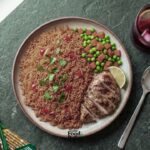



The best nutrition app for Nigerians right now is one that actually recognises egusi soup, pounded yam, and jollof rice. Most apps don’t. That’s the honest answer you need before you download anything.
Too many people grab MyFitnessPal, spend 20 minutes searching for their mama put plate, find nothing useful, and give up entirely. The problem is that most nutrition apps were built for people eating chicken breast and brown rice, not pounded yam with ofe onugbu.
So how exactly do you get your diet right with these apps?
Why Does the Right Nutrition App Matter So Much for Nigerians?
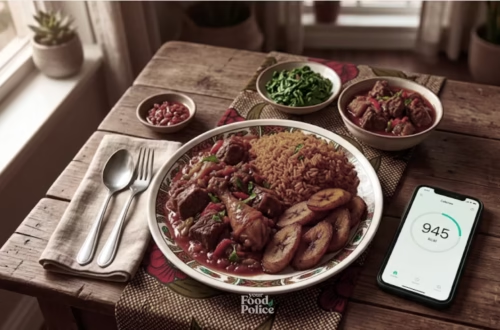
A nutrition app is only useful if it can track what you actually eat. For most Nigerians, that means soups, swallows, stews cooked at home, buka meals with no packaging, and market ingredients with no barcodes.
Most widely recognised calorie counters do not provide accurate results for Nigerian or African food because they were built on Western databases.
The entries that do exist are often user-submitted and wildly inconsistent, and no reasonable averages exist for dishes that every family cooks differently. One entry says a plate of jollof is 200 calories. Another says 600. Both can’t be right.
For daily calorie and macro tracking to actually be useful, you need at least 95% accuracy in your food data. Anything less and the numbers are decorative, not functional. So when choosing a nutrition app, Nigerian food database coverage is the whole point.
What Should a Good Nutrition App Be Able to Do?
Before talking about specific apps, here’s what to look for when evaluating any nutrition app for use in Nigeria.
- Nigerian or African Food Database
This is non-negotiable. If the app doesn’t have egusi soup, moi moi, akara, eba, pounded yam, and suya, you’ll spend more time creating custom entries than actually tracking.
A good nutrition app should cover at least 500 Nigerian or African food items, with verified macronutrient data.
- Custom Food and Recipe Entry
Since a lot of Nigerian cooking happens from scratch, the ability to build your own recipes is essential. You should be able to enter ingredients, set a serving size, and save that recipe. Next time you make ogbono soup, one tap and you’re done.
- Macro and Micronutrient Breakdown
Calories are a starting point, but a quality nutrition app should also break down your intake of carbohydrates, protein, fat, iron, calcium, vitamin A, and vitamin C.
These micronutrients matter a lot, especially for women of reproductive age and anyone managing conditions like anaemia or hypertension.
- Barcode Scanner
Useful for packaged products you’ll find in ShopRite, Justrite, or your local supermarket. It won’t help with your mama’s egusi, but it handles the packaged stuff well.
Top 2 Best Nutrition Apps
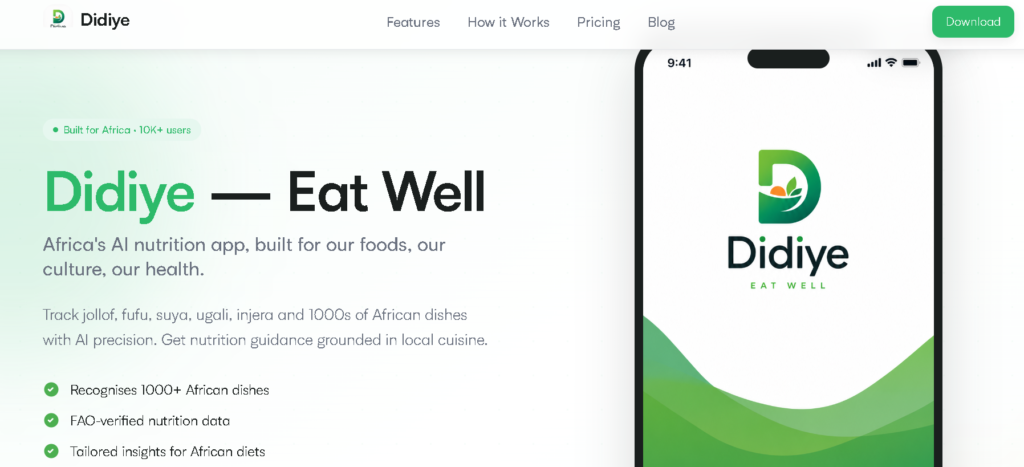
Didiye is currently the best nutrition app for Nigerians who want accurate food data for local dishes. It’s built specifically for African diets and includes over 1,000 African dishes, from Nigerian jollof and fufu to Ghanaian kelewele.
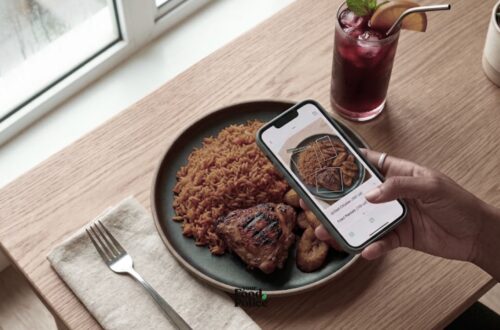
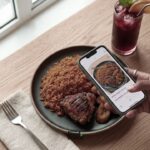
Didiye uses AI photo recognition trained on African foods, so you can snap a picture of your plate and get an instant nutritional breakdown.
It knows the difference between Nigerian jollof and Ghanaian jollof. It can estimate portions of fufu. It has a community of over 10,000 Africans using it across Lagos, Accra, London, and beyond.
Is it perfect? No. It doesn’t have a barcode scanner yet, and it still has gaps in its database for some regional Nigerian dishes. But for the core problem of tracking everyday Nigerian meals, it’s the most purpose-built solution available right now.
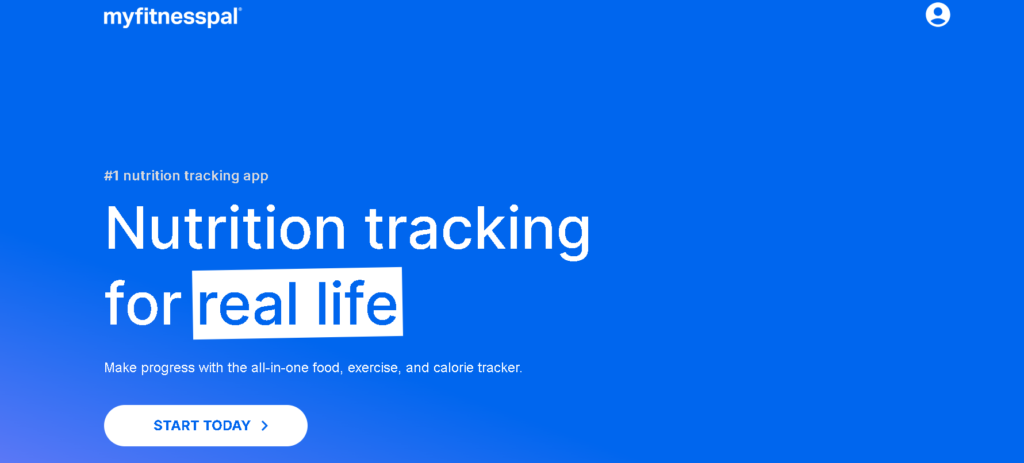
MyFitnessPal still holds the largest general food database with over 14 million food entries globally. For Nigerians eating packaged foods, restaurant meals from international chains, or trying to track supplements, it’s hard to beat.
The issue is accuracy for local dishes. MyFitnessPal is largely an unverified database, meaning that anyone can enter any information which shows up in search.
The reason it works so well for non-Nigerian foods is that most of those foods are pre-packaged, so the company that packages the food has done the heavy lifting. For Nigerian dishes, you’re on your own.
The workaround used by Nigerian nutrition professionals is to manually verify each Nigerian food entry before saving it, cross-referencing with reliable calorie data from sources like Calorie Naija.
That’s extra work, but it does make MyFitnessPal workable. Its barcode scanner is excellent and the interface is familiar to most people.
Which Nutrition App Is Best for Tracking Micronutrients?
Cronometer is the most precise nutrition app for micronutrient tracking, and it’s the one I’d recommend to clients managing specific health conditions like anaemia, vitamin D deficiency, or hypertension.
Cronometer offers an in-depth breakdown of the calories, food groups, macronutrients, vitamins, and minerals you consume. It integrates with popular fitness trackers, consolidating all your health data in one place.
While most apps stop at carbs, protein, and fat, Cronometer tracks over 80 different nutrients including iron, zinc, magnesium, folate, vitamin B12, and omega-3 fatty acids.
For a Nigerian diet, this depth is valuable. Many Nigerians consume adequate calories but fall short on iron and zinc, especially on plant-heavy diets.
The downside is that Cronometer’s Nigerian food coverage is limited. You’ll need to build out your own recipe library. Once you’ve done that work, though, the depth of data you get back is unmatched by any other free nutrition app.
How Do I Start Using a Nutrition App if I Eat Nigerian Food Every Day?
This is where most guides abandon you. Here’s a practical step-by-step that actually works for Nigerian eating patterns.
- Download your chosen app. Didiye for local food focus, Cronometer for micronutrients, MyFitnessPal for the largest database.
- Set your goal: weight loss, weight gain, muscle building, or general health monitoring. This determines your daily calorie and macro targets.
- Spend your first week building your personal Nigerian food library. Log every meal you eat regularly and create custom entries if the dish isn’t in the database. Use Calorie Naija as your reference for verified Nigerian dish data.
- Use the barcode scanner for any packaged Nigerian foods
- For buka or mama put meals, estimate by ingredient. If you had a plate of jollof rice with chicken, log them separately. Most nutrition apps let you search by individual ingredient.
- Log consistently for at least two weeks before making any dietary decisions based on the data. One week isn’t enough to see patterns.
- Review your weekly summary every Sunday. Are you consistently under-eating protein? Over-relying on carbs at dinner? This is where the actual insight happens.
What About Nutrition Apps That Use AI or Photo Logging?
AI-based photo logging is the most exciting development in the nutrition app space right now, and it’s especially useful for Nigeria where most food has no barcode and portions are estimated by eye.
Didiye leads here for African food. You point your camera at your plate and it identifies the dish and estimates calories and macros instantly.
Soups are harder to photograph than solid foods, and portion estimation from a 2D image has real limits. But for a plate of jollof or a serving of suya, it works well enough to be genuinely useful.
Use AI photo logging as a starting point, not a definitive number. Treat it as an estimate within a 10-15% range and adjust based on what you know about how your food was actually prepared.
FAQs
Q: Is there a nutrition app that knows Nigerian food?
A: Yes. Didiye is currently the best nutrition app built for African and Nigerian foods, with over 1,000 local dishes in its database including jollof rice, fufu, suya, and egusi soup. Calorie Naija is also a useful free web-based reference for Nigerian meal calorie data.
Q: Can I use a food tracking app without mobile data in Nigeria?
A: FatSecret offers partial offline functionality, letting you log meals without an active data connection. MyFitnessPal also has limited offline access. Most other nutrition apps require internet for full functionality, so this is a real limitation to plan around if your data is unreliable.
Q: Is MyFitnessPal accurate for Nigerian foods?
A: Partially, but not reliably. MyFitnessPal’s Nigerian food entries are user-submitted and unverified, which means calorie counts for the same dish can vary wildly.
To use it accurately for Nigerian food, cross-check entries against verified sources like Calorie Naija before trusting the numbers.
Q: What is the best free food tracking app for Nigeria in 2026?
A: FatSecret is the best completely free food tracking app available in Nigeria right now. It has no ads, no paywall on core features, partial offline access, and a barcode scanner.
For Nigerian-specific food data, pair it with Calorie Naija as your reference for local dish calorie counts.