






Google AI Overviews can be useful starting points, but they should not be your final word on nutrition.
They frequently oversimplify, omit Nigerian food context entirely, and sometimes surface outdated or outright wrong information. For anything that affects your health, treat AI Overviews as a lead and not the final.
What Is Google AI Nutrition Information?
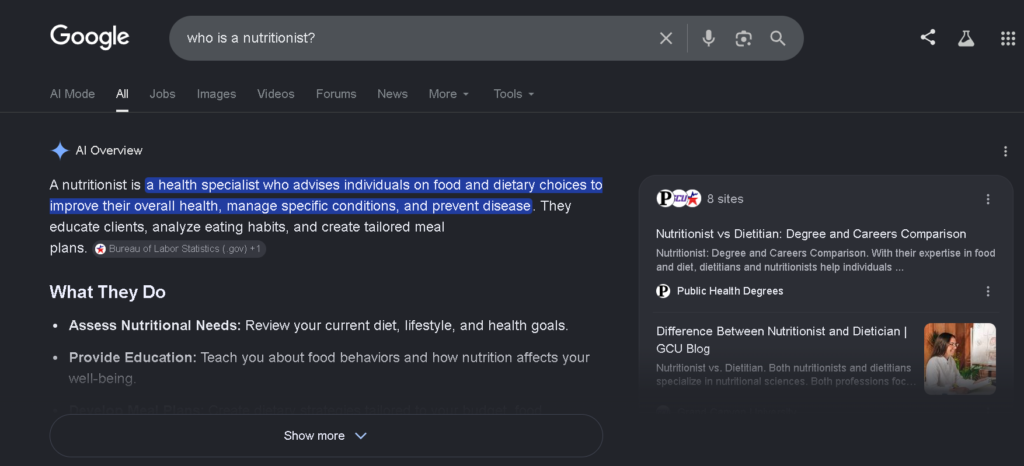
When you search something like “is eba good for weight loss” or “how much protein does moi moi have,” Google may now answer you directly at the top of the page before showing any links.
That box is an AI Overview, and it’s generated by Google’s Gemini model synthesising content from multiple web sources.
The appeal is obvious. No clicking. No reading. Just an answer.
The problem is that nutrition is not a field where fast answers are always right answers.
How Accurate Is Google AI Nutrition Information for Nigerian Foods?
For Nigerian foods specifically, Google AI nutrition information has a significant blind spot: the data is thin.
Most nutrition databases that AI tools draw from, including the USDA FoodData Central, were built around Western diets.
Egusi soup, ogi, suya, efo riro, agege bread, these foods are either absent, poorly documented, or listed with nutritional values that don’t reflect how they’re actually prepared in Nigerian homes.
I often have to cross-reference the West African Food Composition Table published by FAO and INFOODS, because the mainstream databases simply don’t have reliable entries.
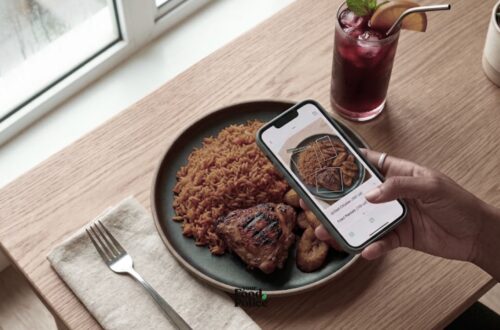
So when Google AI generates a figure for, say, the caloric content of a plate of jollof rice, ask yourself: which jollof? How much oil? What size plate? Prepared how?
The AI doesn’t know. It’s averaging across whatever it found online, which may include a recipe written in the UK using basmati rice.
What the Research Says About AI Health Accuracy
A 2025 study published in Nutrients evaluated the diet quality and caloric accuracy of meal plans generated by three AI chatbots, Gemini, Microsoft Copilot, and ChatGPT 4.0, and found meaningful gaps in how well these tools performed across varying caloric targets.
When the questions got complex or condition-specific, accuracy dropped significantly.
Nutrition is context-dependent almost by definition.
The right amount of carbs for a 25-year-old student on a ₦5,000 food budget in Ondo is completely different from what a 38-year-old professional training at a Lagos gym needs.
Where Does Google AI Health Advice Go Wrong?
It Flattens Nuance Into Soundbites
Take fibre. An AI Overview might tell you “eat more fibre for weight loss.” That’s technically true but incomplete. It won’t tell you that suddenly increasing fibre from ogi to a high-bean diet can cause significant bloating, especially if you’re not drinking enough water.
It won’t tell you that if you have Irritable Bowel Syndrome (IBS), certain high-fibre foods can make things worse, not better.
It Cites Sources You Can’t Always Verify
AI Overviews sometimes show citations, but Google doesn’t always surface which specific claim came from which source.
The citations at the bottom may support some of what’s written, but not necessarily the sentence you’re reading. This is a meaningful transparency gap for health content.
It Doesn’t Know Your Context
Google AI health advice cannot account for:
- Your medical history (diabetes, hypertension, kidney disease)
- Your budget and what’s actually available in your market
- Your cooking method (fried, boiled, stewed)
- Your Nigerian food culture and eating patterns
- Drug-nutrient interactions if you’re on medication
A blanket recommendation to “increase potassium intake” sounds harmless until you’re on a medication that already raises potassium levels. AI doesn’t flag this. A registered dietitian does.
Is Google AI Nutrition Information Better Than Nothing?
Here’s a fair answer: sometimes, yes.
For basic questions with well-established answers, AI Overviews do reasonably well. Questions like “what does vitamin C do,” “which foods are high in iron,” or “how many calories are in a banana” are unlikely to produce dangerous misinformation.
The science on this is settled, and the information is widely reproduced accurately.
The risk climbs sharply when the question becomes:
- Condition-specific (“what should I eat for PCOS”)
- Drug-related (“what foods interact with metformin”)
- Culturally specific (“is garri bad for a diabetic”)
- Weight loss or gain protocols
For these categories, AI Overviews are genuinely risky as a sole source of guidance.
How Does Google AI Compare to Other Sources for Nutrition Advice?
| Source | Strengths | Weaknesses |
| Google AI Overviews | Fast, accessible, covers broad topics | Oversimplified, poor Nigerian food data, no personalisation |
| Registered Dietitian/Nutritionist | Personalised, medically informed, culturally aware | Costs money, limited access in many Nigerian cities |
| Government Health Sites (WHO, FMOH) | Evidence-based, credible | Often not Nigeria-specific, slow to update |
| Nigerian Dietetics Association (NDA) | Locally relevant | Limited online content, hard to find |
| Nutrition apps (Cronometer, MyFitnessPal) | Tracks data, some Nigerian foods added | Incomplete Nigerian database, requires self-reporting |
| Peer-reviewed journals | Highest accuracy | Dense, requires interpretation |
The honest answer is that no single source is complete. The best approach layers credible sources and uses a qualified professional for anything with real health stakes.
What Should You Do When Google AI Gives You Nutrition Information?
Here’s a practical approach I recommend:
- Read the AI Overview as an orientation, not a conclusion. It tells you the general information, not the specifics that you need.
- Scroll past the AI box and check the actual sources. Is it a registered dietitian’s website? A peer-reviewed study? Or a random wellness blog? The source quality matters enormously.
- Ask whether the advice accounts for Nigerian food culture. If the answer recommends Greek yoghurt, quinoa, or chia seeds as key foods, it wasn’t built with your context in mind.
- Cross-check condition-specific information with the World Health Organisation or the Nigerian Dietetic Association. Both have credible, accessible content.
- Consult a professional for anything involving a health condition. Especially diabetes, hypertension, kidney disease, pregnancy, or significant weight concerns. In Nigeria, you can find registered dietitians through the Nigerian Dietetic Association or major teaching hospitals like LUTH, UCH Ibadan, or UNTH Enugu.
Can You Trust AI for Calorie and Macro Information on Nigerian Foods?
Mostly, no. Not yet.
Calorie and macro data for Nigerian foods vary wildly depending on preparation. A cup of egusi soup made with a generous pour of palm oil and stockfish has a very different nutritional profile from a lighter home version.
AI tools pull from whatever data is available, and for Nigerian dishes, that data is often from food bloggers who didn’t measure ingredients, or from databases where “Nigerian” is a checkbox, not an actual analysis.
The FAO/INFOODS West African Food Composition Table remains one of the more reliable references for Nigerian food data, and even that has significant gaps.
Until a comprehensive, lab-verified Nigerian food composition database exists, treat AI-generated macros for Nigerian foods as ballpark estimates with meaningful margins of error.
FAQs
Q: Can I use Google AI health advice instead of seeing a doctor or nutritionist?
A: No. Google AI is not a substitute for a qualified professional, especially for condition-specific nutrition. Use it to inform your questions, not replace the consultation.
Q: Why does Google AI sometimes give different answers to the same nutrition question?
A: AI Overviews synthesise from multiple sources, and those sources may contradict each other. Nutrition research itself contains conflicting findings, and AI doesn’t always resolve those conflicts correctly. This is why you’ll sometimes get different answers on different days.
Q: Is Google AI nutrition information safe for diabetics to follow?
A: Not without professional supervision. Diabetes nutrition is highly individualised and depends on your specific glucose response, medication, activity level, and food access. Generic AI advice on carb restriction or food avoidance can be actively harmful without clinical guidance.
Q: Does Google AI understand Nigerian foods and portion sizes?
A: Only partially. Major Nigerian foods like rice, yam, and plantain appear in some databases, but most traditional dishes, soups, and local snacks are poorly represented. Portion size conventions also differ significantly between Nigerian and Western eating habits, so AI estimates are often inaccurate.