




NAFDAC has tightened food labelling in Nigeria, and more changes are on the way.
Every pre-packaged food sold in the country must already carry a full ingredient list, a batch number, and a valid NAFDAC registration number.
On top of that, new rules for bulk and non-retail containers are in the works, and front-of-pack warning labels for sugar, salt, and fat are moving from proposal to policy.
If you run a small food business, shop for your family, or just want to know what you’re eating, this labelling shake-up affects you directly. Let’s break down what’s required now, what’s new, and how to actually use a label the next time you’re standing in front of a shelf in Shoprite or your local market.
What Does Nigeria’s Current Food Labelling Law Require?
Every pre-packaged food sold in Nigeria must display the product name, full ingredient list, net content, manufacturer details, manufacture and expiry dates, storage conditions, batch number, and NAFDAC registration number.
This baseline comes from the Pre-Packaged Food (Labelling) Regulations 2022, and it applies to everything from sachet water to imported cereal.
Most Nigerians only check the expiry date and skip the rest(and some don’t even check that). However, the regulation actually covers a lot more ground than that. Here’s what a compliant label must show, according to NAFDAC’s food labelling requirements:
- Product name, written boldly and describing the true nature of the food, not a vague or misleading name
- Ingredient list, in descending order of weight, with allergens like groundnut or milk clearly flagged
- Net content, shown by weight, volume, or count depending on the food type
- Manufacturer details, including the name and address of whoever made, packed, or imported the product
- Manufacture and best-before dates, written as DD/MM/YYYY
- Storage conditions, especially for anything that spoils fast in Nigerian heat
- Batch number, which helps NAFDAC trace a product if there’s a recall
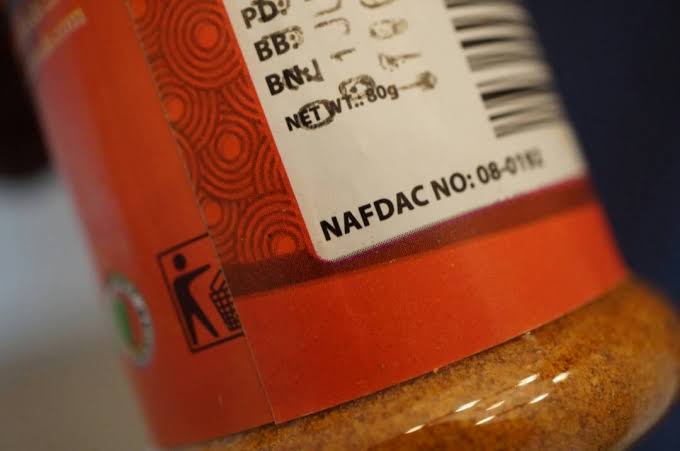
- NAFDAC registration number, the alphanumeric code (NAFDAC Reg. No.) that proves the product passed regulatory checks
Because of this last requirement, checking for a NAFDAC number remains the fastest gut check before you buy anything packaged. If a sachet drink or pack of biscuits has no number on it, treat that as a red flag.
What’s New in Nigeria’s Food Labelling Rules for 2026?
Three things are changing at once. NAFDAC has drafted new rules for bulk and non-retail containers, it launched a nationwide label-literacy campaign in June 2026, and it’s building toward mandatory front-of-pack warning labels for unhealthy products.
New Rules for Bulk and Non-Retail Containers
Until now, the 2022 regulation mostly focused on retail packs, the kind you pick up individually at a supermarket.
That’s changing.
NAFDAC has drafted the Non-Retail Container of Foods (Labelling) Regulations 2025, which sets out labelling rules for the large sacks, crates, and cartons used to move food between manufacturers, distributors, and bulk buyers.
This matters more than it sounds. Market women who buy rice or beans in 50kg bags, and restaurant owners who source cooking oil in bulk jerrycans, will start seeing standardised labelling on those containers too.
As a result, tracing contaminated or fake bulk food back to its source becomes easier for regulators.
The Read the Food Label Campaign
In June 2026, NAFDAC launched the “Read the Food Label” campaign alongside the World Health Organisation, UNICEF, the University of Abuja, and Corporate Accountability and Public Participation Africa.
The campaign’s goal is simple: teach ordinary Nigerians how to actually read the labels that already exist on their food.
NAFDAC’s Director-General, Prof. Mojisola Adeyeye, has spoken publicly about developing her own label-checking habit after her son reacted to a food additive as a child.
Citing WHO figures, she noted that non-communicable diseases like hypertension, diabetes, and cardiovascular disease now account for roughly 29 percent of all deaths in Nigeria. That statistic is the whole reason labelling policy is speeding up.
Front-Of-Pack Warning Labels
Meanwhile, front-of-pack (FOP) warning labels, the bold “HIGH IN SUGAR” or “HIGH IN SALT” symbols you might have seen on Chilean or Mexican products, are moving from research to policy in Nigeria.
According to The Sun Nigeria’s coverage of the campaign launch, research from the University of Abuja has already informed national policy work on nutrient profiling and front-of-pack labelling.
These labels aren’t compulsory yet, but the groundwork is clearly being laid, and food manufacturers should expect them within the next policy cycle.
Why Is NAFDAC Pushing Front-Of-Pack Warning Labels Now?
Because most Nigerians can’t easily interpret the nutrition tables on the back of a pack, and unhealthy diets are driving a rise in chronic disease.
A report from EnviroNews points out that consumers with lower literacy or education levels face the biggest barriers to understanding detailed nutrition panels. A simple “HIGH IN…” warning on the front of the pack removes that barrier instantly.
There’s also a business angle here that’s worth knowing. When a warning label becomes mandatory, manufacturers tend to reformulate their products rather than wear the warning. In countries that adopted FOP labelling, several brands quietly cut sugar and sodium levels just to avoid the stamp.
If Nigeria follows that pattern, expect some of your favourite drinks and snacks to taste a little different in the next few years, and that’s arguably a good thing for public health.
How Do You Actually Read a NAFDAC Food Label?
Reading a label properly takes less than a minute once you know what to check. Here’s a simple sequence to run through before anything goes into your basket.
- Check for a NAFDAC registration number. No number means the product hasn’t been through regulatory checks, so skip it.
- Read the ingredient list, not just the front of the pack. Ingredients are listed by weight, so whatever comes first is what you’re mostly eating.
- Look at the sugar, salt, and fat content. These sit in the nutrition information panel, usually printed per 100g or per serving.
- Confirm the expiry date, not just the manufacture date. A product can be freshly made but still close to its best-before date.
- Check the batch number. If NAFDAC ever recalls that batch, this is how you’d know your specific pack is affected.
- Scan for allergen warnings. These are bolded or separated out, especially for milk, groundnut, soy, and gluten.
Following this sequence turns label reading into a quick habit rather than a chore, and it’s exactly the habit NAFDAC’s new campaign is trying to build nationwide.
What Happens if a Business Breaks Nigeria’s Labelling Rules?
NAFDAC can seize, destroy, or block registration for any food product that fails to meet labelling requirements.
The agency runs regular market surveillance sweeps, and unregistered or mislabelled products are routinely pulled from shelves, especially sachet water, informally packaged snacks, and bulk goods sold without proper documentation.
At the agency’s 2026 World Food Safety Day event, officials again urged Nigerians to avoid products without proper labelling or a traceable NAFDAC registration number, since these are usually the first signs of a compromised product.
For small food businesses, this means labelling compliance isn’t optional paperwork. It’s the difference between staying on the shelf and getting shut down.
Old Rules vs New Rules: What’s Changing
| Labelling requirement | Pre-2025 baseline | 2026 direction |
| Retail pack labelling | Mandatory under the 2022 regulation | Unchanged, still enforced |
| Bulk and non-retail containers | Loosely covered, mostly informal | Formal rules drafted under the 2025 Non-Retail Container Regulation |
| Nutrition information | Present but often ignored by shoppers | Actively promoted through the Read the Food Label campaign |
| Front-of-pack sugar, salt, and fat warnings | Not required | Policy groundwork underway, expected to become a requirement |
| Consumer label literacy | Left to individual initiative | Backed by a national campaign with WHO, UNICEF, and university research |
FAQs
- What must appear on a NAFDAC food label?
A compliant label needs the product name, ingredient list, net content, manufacturer details, manufacture and expiry dates, storage instructions, batch number, and NAFDAC registration number. Missing any of these can get a product flagged during NAFDAC’s market checks.
- Are front-of-pack warning labels compulsory in Nigeria yet?
Not yet. Research and policy work on nutrient profiling and front-of-pack labelling are underway, but manufacturers aren’t legally required to display “HIGH IN SUGAR” or similar warnings as of mid-2026.
- How do I check if a product has a valid NAFDAC number?
Look for the alphanumeric NAFDAC Reg. No. printed on the pack, then treat products without one as unverified. NAFDAC’s ongoing campaigns consistently advise Nigerians to avoid buying anything without a visible, traceable registration number.
- What is the Non-Retail Container of Foods Labelling Regulation?
It’s a newer set of rules covering bulk containers like sacks, crates, and jerrycans used to move food between manufacturers and distributors, rather than individual retail packs. It’s designed to make bulk food easier to trace if something goes wrong.